 Jumperexchange
Jumperexchange slippage tolerance links quoted output to the minimum accepted amount
Jumperexchange slippage tolerance defines how much adverse movement a quoted swap may accept before its minimum-output check rejects the trade. The quote already reflects the selected amount and available liquidity. A wider tolerance permits a lower output floor; it does not improve that quote. Compare the estimated amount with the returned minimum before authorizing execution. For a cross-chain swap, a rejected destination conversion can leave a bridged asset, so inspect the delivered token before retrying.
UpdatedLiquidity and timing change executable output
Executable output changes with liquidity and prices between quote calculation and execution, so an initially acceptable estimate can become incompatible with the accepted output floor. In a pool-based swap, the trade’s own size can move the pool’s price; this is price impact. That effect can already shape the quote, while other trades can alter prices and liquidity before execution. Realized slippage describes the difference between the quoted result and the actual execution result. Tolerance sets the permitted adverse difference. It cannot restore liquidity or prevent market movement.
A tighter tolerance rejects more adverse outcomes. A wider setting accepts larger shortfalls, while the same liquidity constraints continue to shape execution.
The amounts behind a quoted rate
A quoted rate relates the expected output to the selected input amount, while the minimum output states the floor for acceptable execution. These quantities have different purposes even when they appear together.
Expected output and the acceptance floor
The quote estimate
The
toAmount
field holds estimated output for the requested token. Its relationship to the input amount gives the quoted rate. That estimate can already reflect trade-size effects and route costs. Comparing it with a separate market price does not isolate the movement that occurs after quoting.
The returned minimum
The
toAmountMin
field separates the acceptance floor from the expected result. Both concern output, while
fromAmount
concerns input. A quote response supplies proposed execution details; it does not establish that tokens have arrived.
Token units behind the amounts
Raw quote amounts use the token’s smallest units. Convert an amount with
d
decimals by dividing its raw integer by
10^d
. Apply the same conversion to expected and minimum output before comparing them. The token address and chain identify which asset those units represent. An output token amount, its dollar valuation, and gas paid in another asset measure different things.
Minimum-output arithmetic for the selected quote
Minimum-output arithmetic connects the estimated amount with the shortfall that the returned threshold permits, using identical output-token units for both values. Let
Q
denote expected output and
M
denote its minimum. The output buffer is
Q - M
. For a positive estimate, its percentage is
100 * (Q - M) / Q
. If
b
represents that buffer as a fraction of
Q
, then
M = Q * (1 - b)
. This expresses the minimum as a fractional reduction from the estimate. The measured buffer need not equal a single entered tolerance across a multi-step route.
The quote API from Jumperexchange’s routing provider encodes slippage tolerance as a decimal fraction:
0.005
means 0.5%. This notation describes a parameter, not a mandatory setting for every Jumperexchange route.
The returned
toAmountMin
defines the quote’s minimum output after applicable slippage adjustments.
Multi-step allowances and provider-specific behavior can change its relationship to a single entered percentage. Use the returned amount when evaluating the proposed execution.
Quote review through output reconciliation
An exact-input swap aims to exchange the selected input amount for an acceptable quantity of the requested token, with delivery providing the final evidence. Start with the returned quote and its minimum. Reviewing that floor establishes whether the proposed output meets your requirement before execution authorization.
| Execution stage | Observable change | Output or execution condition |
|---|---|---|
| Quote returned | An estimate and minimum describe proposed output. | The selected token, chain, and amount need an available route. |
| Minimum accepted | You accept the quoted output floor. | A minimum below the acceptable amount calls for rejecting the quote before signing. |
| Allowance checked and quote refreshed | Any required approval confirms; a fresh quote updates execution data. | Recheck the refreshed minimum before signing; an approval alone completes no swap. |
| Swap execution | The contract evaluates output against its enforced minimum. | Output below that threshold can revert the affected swap. |
| Delivery reconciled | The receipt and destination status identify the delivered asset and amount. | A source-chain confirmation alone cannot establish cross-chain output. |
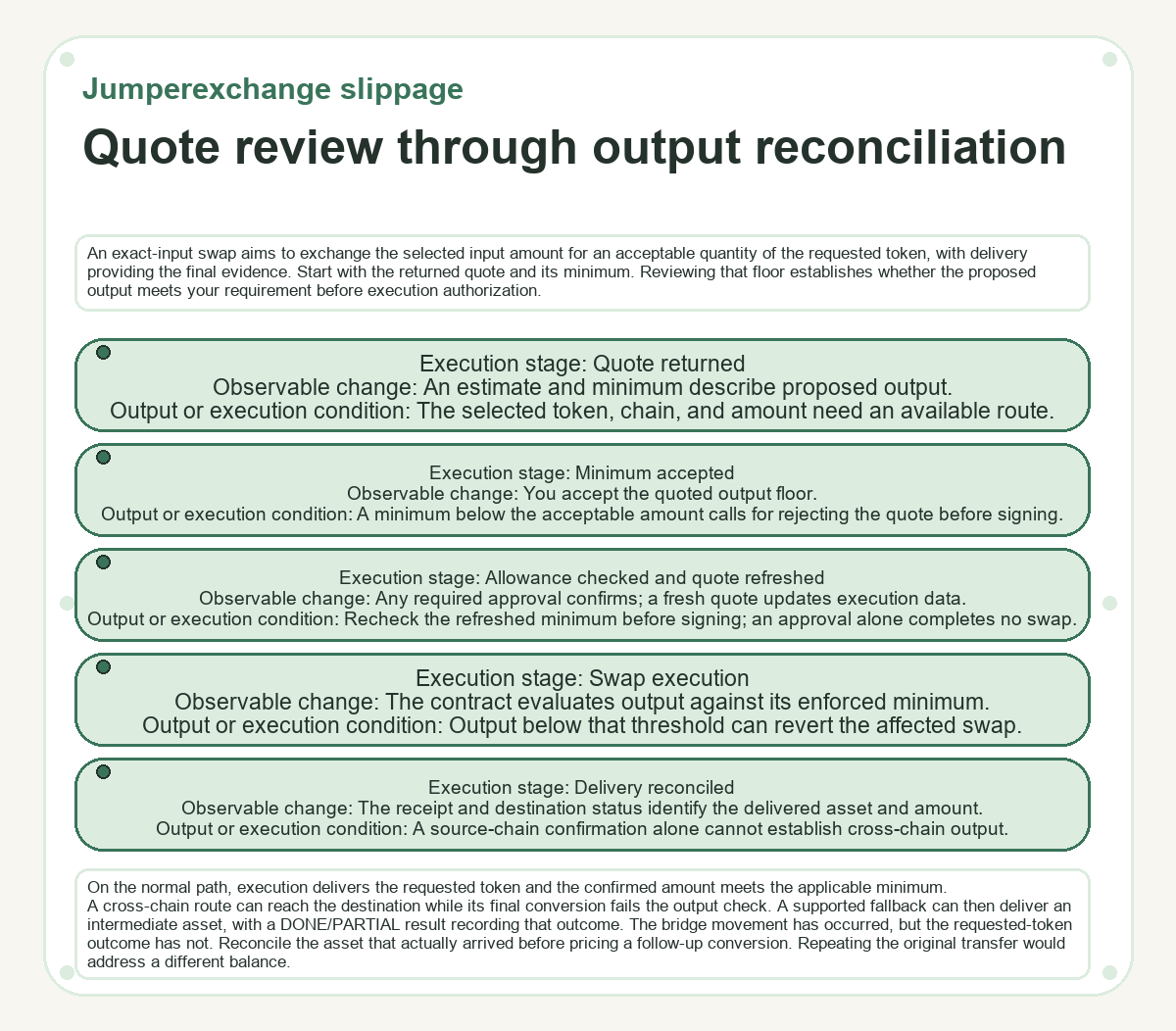
Quote review through output reconciliation
- Execution stage: Quote returned Observable change: An estimate and minimum describe proposed output. Output or execution condition: The selected token, chain, and amount need an available route.
- Execution stage: Minimum accepted Observable change: You accept the quoted output floor. Output or execution condition: A minimum below the acceptable amount calls for rejecting the quote before signing.
- Execution stage: Allowance checked and quote refreshed Observable change: Any required approval confirms; a fresh quote updates execution data. Output or execution condition: Recheck the refreshed minimum before signing; an approval alone completes no swap.
- Execution stage: Swap execution Observable change: The contract evaluates output against its enforced minimum. Output or execution condition: Output below that threshold can revert the affected swap.
- Execution stage: Delivery reconciled Observable change: The receipt and destination status identify the delivered asset and amount. Output or execution condition: A source-chain confirmation alone cannot establish cross-chain output.
On the normal path, execution delivers the requested token and the confirmed amount meets the applicable minimum.
A cross-chain route can reach the destination while its final conversion fails the output check. A supported fallback can then deliver an intermediate asset, with a
DONE/PARTIAL
result recording that outcome. The bridge movement has occurred, but the requested-token outcome has not. Reconcile the asset that actually arrived before pricing a follow-up conversion. Repeating the original transfer would address a different balance.
Price-change errors and output rejection
An output rejection means that the affected execution cannot satisfy its accepted threshold under the conditions that the check evaluates. The error wording depends on the exchange or routing component that performs the check.
The message “Return amount is not enough” identifies output below the minimum accepted threshold. Volatility and low liquidity can cause it. “Exchange rate has changed” identifies a price change between quoting and execution. These messages describe pricing conditions, yet they do not establish an identical transaction state. A failure during transaction preparation differs from an onchain revert.
A rejected Composer simulation produces an error before submission. An onchain revert follows submission and execution; the receipt records that outcome. Raising tolerance addresses an output constraint only by permitting worse execution. It cannot make a lower floor acceptable to someone whose requirement remains unchanged. Fresh route information can reveal another path or a different amount that fits the available liquidity.
Swap thresholds across separate settlement phases
A cross-chain minimum-output failure applies to the affected swap phase, so it does not make the entire transfer one reversible transaction. Composer executes supported same-chain operations atomically: the steps in that transaction succeed together or revert together. Cross-chain composition through the underlying routing API uses separate source and destination phases. Each phase can be atomic on its own chain while the overall transfer takes time to settle. The same distinction matters for Quick Deposit into Earn positions. A successful source swap alone does not establish the destination deposit, and a tolerance setting cannot promise an automatic bridge refund.
Transaction evidence before another attempt
A retry requires a known prior outcome because an unavailable status response can leave the original execution unresolved, even after a slippage-related message appears. Keep the original transaction hash and its source-chain receipt separate from the transfer identifier. A transfer identifier does not substitute for a blockchain transaction hash. Cross-chain status adds the receiving token, amount, chain, and substatus.
NOT_FOUND
, or HTTP
404
with code
1003
, does not prove failure. A polling timeout also leaves the outcome unknown. Those states require reconciliation of the existing transfer before another submission.
A confirmed output below the applicable returned minimum needs investigation of that route’s quote and execution. Preserve the original amounts in token units, along with the received asset’s exact identity, so the comparison concerns the same output.
Before you start with Jumperexchange slippage
Does setting Jumperexchange slippage to zero make every swap fail?
A zero tolerance does not automatically make every swap fail. The underlying quote API accepts a zero slippage value, and execution can succeed when output satisfies the transaction’s enforced minimum. Price stability alone does not establish that condition: available liquidity, the selected route’s checks, and other execution constraints still apply.
Will a higher slippage tolerance fix insufficient funds for execution?
Increasing slippage does not supply a missing input balance or transaction gas. Quote data includes gas estimates, which describe another requirement alongside acceptable output. An error caused by insufficient funds needs a balance assessment.
How can transfer taxes affect the quoted minimum output?
A transfer tax can affect received tokens separately from ordinary execution price movement. For known-tax tokens that pass the routing engine’s tax screening, quotes may adjust both expected and minimum amounts. The adjustment depends on available tax information. It cannot account for every dynamic or undetected tax, so the entered tolerance alone does not describe every deduction.
Can an automatic recommendation override an explicit API slippage value?
An explicit slippage value takes precedence over the underlying quote API’s Smart Slippage recommendation. Smart Slippage defaults apply only when that feature is enabled for the integration and the request omits a tolerance. Per-step recommendations remain advisory metadata and can differ from the earlier server-selected default because they consider actual intermediate tokens.
Is the fastest route also the route with the smallest output buffer?
A route sorted for speed does not necessarily have the smallest permitted output shortfall. The underlying quote API’s FASTEST sorting prioritizes estimated execution time. CHEAPEST sorting considers economic output and gas costs. Neither label establishes which quote has the narrowest difference between expected and minimum output; that comparison requires the returned amounts.
Can changing the slippage setting modify an already broadcast swap?
Changing an interface setting does not rewrite an already broadcast EVM transaction. Its signed input data carries the conditions encoded for that execution. A newly generated quote describes another proposed transaction. The pending transaction’s encoded conditions and eventual receipt remain relevant even when the screen displays a different tolerance or a refreshed output estimate.
Does slippage tolerance control a swap’s transaction deadline?
Slippage tolerance controls acceptable output, while a transaction deadline controls execution time where the selected route includes one. Increasing tolerance does not extend that deadline. A fresh quote can describe new transaction conditions, so an older payload and a newer displayed quote are separate records. Check the conditions of the transaction that will actually execute.
When should I refresh a Composer quote while reviewing its minimum output?
For Composer routes through the swap and bridge API from Jumperexchange’s routing provider, refresh the quote after a required token approval confirms. That integration also calls for re-fetching before signing when review lasts more than 30 seconds, because pricing and simulation results can become stale. This refresh recommendation concerns that execution flow; it does not establish a universal expiry time for every Jumperexchange quote.