 Jumperexchange
 Jumperexchange vault data and execution behind Earn
Jumperexchange connects Earn vault discovery and portfolio tracking with Quick Deposit execution through LIFI Earn. Its data layer describes yield opportunities, while LIFI Composer coordinates supported conversions and deposits. Historical APY helps interpret past vault performance; route costs, vault rules, and execution support determine whether a particular deposit works.
UpdatedIn short: Historical APY describes past vault performance, while Quick Deposit must satisfy the funding route and the selected vault’s deposit rules.
Wallet holdings and opportunity matching
The assets in a connected wallet help Jumper Earn match available opportunities to existing holdings and onchain behavior. The interface identifies idle assets and presents opportunities relevant to the portfolio. A deposit funded with another asset may require conversion before the vault accepts it, while a deposit on another network may also require bridging.
A portfolio match identifies a candidate opportunity; a deposit requires a separate execution request and wallet authorization.
Vault discovery and transaction orchestration
LIFI Earn combines vault discovery and portfolio data with a separate execution engine, giving each component a distinct responsibility. The Earn Data API supplies structured information that the interface can filter by chain, asset, protocol, APY, and total value locked. This common format lets the application present opportunities from different protocols together. It also preserves the underlying assets and protocol identity that distinguish one position from another. Comparing records does not require treating their strategies or withdrawal terms as equivalent.
Jumper provides the product interface, while LIFI Earn supplies the discovery and execution infrastructure underneath it. Composer handles the contract interactions needed for supported deposits. The data layer also supports tracking an existing position independently of a new deposit. An executable funding route requires the separate execution layer, whose inputs include the source asset and destination vault.
What does historical APY tell you about an Earn deposit?
Historical annual percentage yield, or APY, summarizes a vault’s annualized yield over a past measurement period. It provides comparison context without determining a new deposit’s return. The return on a later position depends on the conditions during that position’s holding period.
Historical measurement windows
Jumper Earn’s vault data includes historical APY for one-day, seven-day, and thirty-day periods. Comparing the same window across opportunities keeps the time basis consistent. Mixing a recent daily figure with a monthly figure combines different histories, even when the interface displays both as percentages.
One-day and seven-day history
The one-day figure concentrates on the most recent daily period, while the seven-day figure covers a week. A difference between them shows that the measurement window affects the reported rate. It does not identify the cause by itself. The vault’s underlying activity and reward structure provide the context needed to interpret that difference.
Thirty-day history
The thirty-day figure gives a longer comparison period for the same vault. It can help distinguish a recent change from the broader monthly history. That longer window also includes older conditions, so it does not establish the rate that a new position will earn.
TVL beside the yield metric
Total value locked, or TVL, measures the value held in the vault rather than an annual yield rate. It adds context about the size of the opportunity. A larger TVL does not establish a particular deposit’s return or prove that its funding route has sufficient trading liquidity. Vault holdings and the liquidity needed to convert the input asset describe different resources.
Shared vault fields across distinct protocols
Standardized vault fields support comparison across protocols while retaining the identity of each opportunity. In May 2026, Jumper Earn’s described offering included 115+ opportunities from 15 DeFi protocols. Aave, Morpho, Lido, Euler, Fluid, and Spark appeared in that lineup. Those dated counts describe that offering, not a permanent catalog size. Shared metadata makes the records comparable; the target protocol and underlying assets still determine what the deposited position represents.
How does Quick Deposit connect a token to a vault position?
LIFI Composer powers the conversion and deposit orchestration behind Jumper Earn’s Quick Deposit. The supported flow can swap the funding asset, bridge value when the destination differs, and execute the vault deposit. These conceptual operations do not establish the number of transactions or permissions that a particular route requires. Token allowances can remain prerequisites to the execution transaction.
Execution on one chain
Composer can combine supported operations on an EVM chain within one atomic transaction. Atomic execution means that the operations succeed together or revert together within that transaction. Its runtime passes outputs from earlier operations into later ones. A deposit can therefore use the amount that the preceding swap actually produces, without treating the earlier quoted amount as an already received balance.
Execution across chains
A cross-chain route through the LIFI API starts with source-chain execution and bridging before destination-chain actions run. Each phase has its own chain boundary. Bridge settlement affects the total completion time, even when the interface launches the coordinated flow with one action. A confirmed source transaction establishes the source-side result; completion of the intended deposit also requires the destination vault operation.
Portfolio balances after a deposit
Jumper Portfolio combines supported DeFi positions in a cross-chain view. LIFI Earn supplies the position data behind that view, including balances and returns across supported protocols. A vault opportunity describes where funds could go; a portfolio position describes holdings associated with the wallet. The interface also supports depositing, withdrawing, and redeploying capital where the relevant operations are available.
Position tracking preserves the available asset and protocol context. A shared dashboard does not make withdrawal terms uniform.
Deposit support and withdrawal support
The Earn Data API reports Composer deposit support and withdrawal support separately. Its
isTransactional
flag identifies deposit support, while
isRedeemable
identifies withdrawal support. Composer integration methods supply these flags, so they describe execution availability through that infrastructure. The underlying vault can have broader capabilities.
Available execution support remains subject to the vault’s contract state and the funding route’s liquidity. A paused or capped vault can reject a deposit, and insufficient trading liquidity can prevent the required conversion. Composer’s simulation can surface these problems before returning transaction data. The conditions apply at execution as well: an earlier data record or successful calculation does not freeze the vault or market state.
Route costs beside the vault rate
Quick Deposit’s funding path may include conversion costs, blockchain gas, and bridge or provider charges. The quote supplies execution estimates, while the historical APY describes vault performance. A percentage shown in the vault data does not deduct the particular route’s entry costs or establish how long a position would need to offset them. Those costs depend on the selected asset, amount, networks, and available liquidity.
Slippage tolerance governs acceptable output changes during conversion. Increasing it permits a wider variation in the execution rate; it does not improve the vault’s historical yield. The route’s quoted output and minimum output belong to funding execution. Neither figure replaces the information about the position’s underlying assets or future returns.
Choosing a vault and a funding route
If your aim is to enter the selected Earn vault, portfolio matching suggests a candidate and Composer supplies a supported funding path. The vault must accept your deposit, and the route must produce the intended position within your chosen output limits.
- Match the target protocol, network, and underlying assets to the position you intend to hold.
- Compare historical APY over the same period, keeping TVL separate from yield.
- Require available deposit support and assess withdrawal support as a separate capability.
- Review the route’s quoted and minimum output alongside its conversion costs, gas, and provider charges.
- Distinguish a signed or submitted transaction from confirmation of the intended vault position.
If the vault rejects your deposit or the route falls outside your cost or output limits, a favorable historical rate cannot make that path meet your requirements. For a cross-chain deposit, the destination position must exist before the intended vault entry is complete.
Catalog coverage and automation boundaries
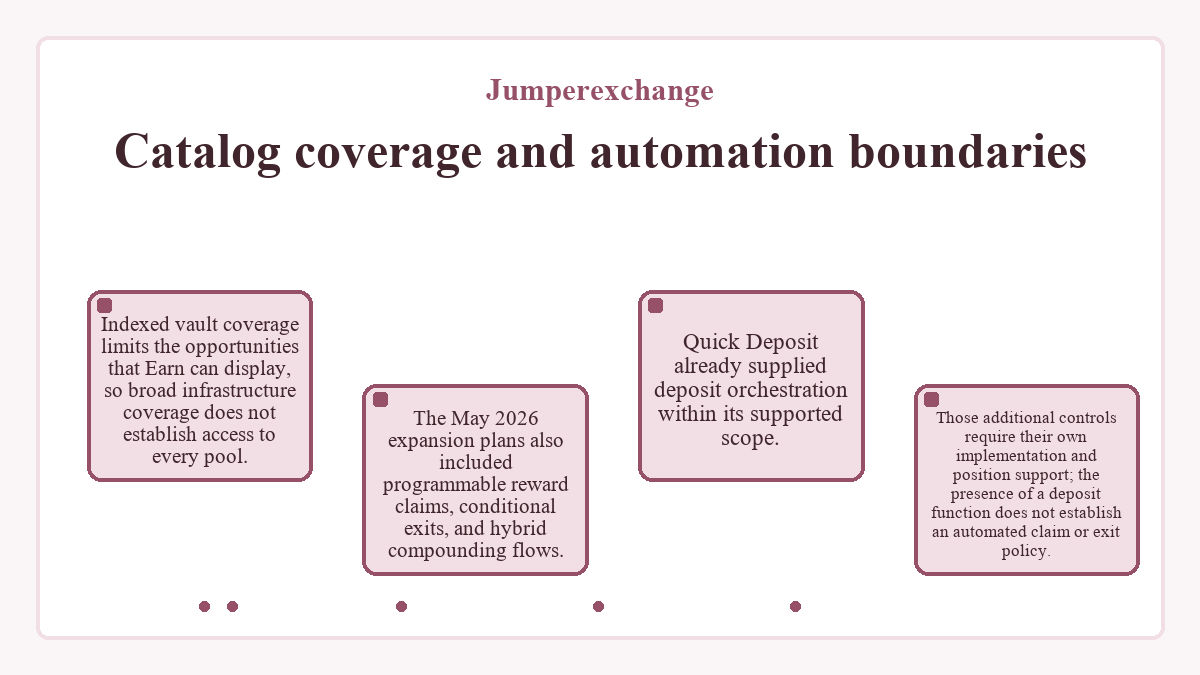
Indexed vault coverage limits the opportunities that Earn can display, so broad infrastructure coverage does not establish access to every pool. The May 2026 expansion plans also included programmable reward claims, conditional exits, and hybrid compounding flows. Quick Deposit already supplied deposit orchestration within its supported scope. Those additional controls require their own implementation and position support; the presence of a deposit function does not establish an automated claim or exit policy.
Popular questions about Jumperexchange
Can a new Earn vault lack thirty-day APY data?
A new vault can have no reported thirty-day APY because the historical field can be null. That missing value does not represent a zero yield. A shorter available history describes only its own period, so it cannot supply the missing monthly measurement.
What does a null reward APY mean in an Earn vault record?
A null reward APY means that the record supplies no numerical value for that component. The data separates base, reward, and total APY. Treating the missing component as zero would add information that the record does not contain, and it would not establish whether additional reward tokens exist.
How frequently does Earn refresh APY and execution availability?
The Earn Data API schedules vault metadata, APY, and TVL synchronization every 15 minutes, and transactional capability synchronization every 2 minutes. These are backend refresh cycles. They describe data maintenance rather than bridge settlement times or a guarantee that the vault’s state remains unchanged between updates.
Does reading Earn vault data require a wallet signature?
Reading vault data through the Earn Data API requires no wallet signature. A custom application can request the data without a connected wallet, subject to the API’s authentication requirements. Deposit execution separately requires a wallet, so permission to retrieve a vault record does not authorize spending tokens.
Which address connects an Earn vault record to a Composer deposit?
The vault record’s contract address identifies the deposit target within its chain context. In the LIFI API integration, that address becomes the quote’s toToken value for a supported vault deposit. The funding token has a separate role; substituting its address would describe a different requested output.
Are withdrawal locks absent when timeLock metadata is missing?
A missing timeLock field does not establish immediate withdrawal access. The field is optional in the normalized vault record. Missing metadata provides no lock duration, so the position’s actual withdrawal terms remain relevant. Composer withdrawal availability and the vault’s own timing conditions describe separate constraints.